Saturday, June 30, 2018

Can You Let Yourself Go With The Flow?


Often times our perfectly planned vacation doesn't go off without a hiccup.  How you react to that hiccup can then set the tone of the rest of your vacation.  So what do you do when you experience that bump in the road that you didn't plan for?

You know, thinking back I don't recall ever having a perfect vacation. And you know what, that's alright by me.  Although at the time it may have been an inconvenience, when I got home it generally added humor when I regaled with my friends my vacation stories.  Two particular journeys come to mind when I think of what could have been vacation lemons that were made into lemonade.


SO AS LUCK WOULD HAVE IT, A TYPHOON BLEW IN...


The first story took place on my very first international scuba vacation.  I jetted off to Beqa, Fiji, to experience my first time diving in warm, tropical waters and I was so excited to be traveling with a group of fellow divers.  Well, the trip had been planned around my dive shop's slow time of the year, which meant we were taking a chance on having excellent weather the whole time. So be it, luck was not exactly with us when a typhoon decided to blow through.  Now of course we couldn't go diving while the winds were howling and the rain was pouring, but were we going to let this ruin our good time? The choices were simple, yes or no.  Well one couple chose to complain to high heavens that this was not the vacation they had paid for and wanted to return home immediately. They opted for locking themselves up in their bure to pout until staff could safely transport them back to the main island of Viti Levu.  The rest of us, however, chose to go with the flow.  We broke out the umbrellas, hopped in the pool and played a raucous game of Marco Polo.  When the winds died down enough for safe sailing, the inpatient couple headed off, and the rest of us continued to enjoy the island, its wonderful people, and eventually some awesome diving.  Do you know what happened to that couple that couldn't just go with the flow and relax?  They sat in a hotel on the main island and had to wait until just the day before we were scheduled to depart before they could get a flight home.  Who do you think had a more enjoyable vacation with a wonderful story to tell when they got home?


MOTHER NATURE PLAYED HAVOC AGAIN...


The second story that comes to mind was when I led a group of divers down to La Paz, Mexico.  Generally, this area is not the victim of large hurricanes, but this had to be the year...just one month before we were to arrive, Baja was struck with one heck of a hurricane leaving a path of destruction from Cabo to Loreto.  I had my phone ringing off the hook and email blowing up from divers in the group wanting to know if we were still going.  When I was finally able to get in touch with the resort and ascertain that, although a little worse for wear, they were still open for business, I let the group know that although the resort may not be in stellar condition, I planned to still lead the trip and help support this community with my tourist dollars to aid in the recovery.  Thankfully everyone in the group was of the same mind and we flew on down.  So yes, we definitely did experience some challenges with plumbing and internet at the resort, but overall the place was in good shape.  On this trip though I did have one diver who admits now that he was not use to being able to let go and just find enjoyment in all the things that were going right. He finally confided in me at the end of the trip that when he realized that yelling at staff was not going to change the fact that some things could not be repaired instantly, his stress levels decreased and his enjoyment levels increased, and it turned out he had a wonderful time.  I felt quite rewarded when he told me that it was my example and attitude that influenced his change and taught him a valuable lesson.  There is peace in letting go and being flexible.


THERE IS PEACE IN LETTING GO & BEING FLEXIBLE...


So tell me, what do you think?  Do you have a story to share about how you turned lemons into lemonade on your vacation?  Didn't your hiccup just add color to what would have otherwise been a typical vacation story?  I'd love to hear from you.


Like what you've read? Want to learn how to better enjoy your scuba diving vacation? Maybe you'd like to travel with Delightful Departures on an upcoming adventure? Become part of the Delightful Departures community. Discover different destinations and travel tips in our biweekly newsletter.  Join today.

Join Our Community


Oxybenzone free sunscreen

Save 10% on your purchase when you apply the coupon code:  delightfuldepartures

Tuesday, June 12, 2018

Tulum - The Mayan City of Trade on the Caribbean Coastline

As I prepare to embark on leading another group trip, I am looking forward to my surface interval adventure on the last day of our adventure before heading home.


Traveling Back in Time


Did you know in the state of Quintana Roo, Mexico, just a little over 80 miles south of the tourism metropolis of Cancun, you can step back into the ancient times of the magnificent Mayan world? Once a booming coastal port providing for the inland city of Cobá, Tulum still stands strong on a Yucatan coastal cliff above the aquamarine waters of the Caribbean Sea.  A reflection of this once thriving city, the well-preserved ruins now stand as the perfect insight into the Mayan way of life from centuries ago.


Last of the Mayan Cities


Tulum got its early beginnings sometime between 250-600 AD, but further developed into
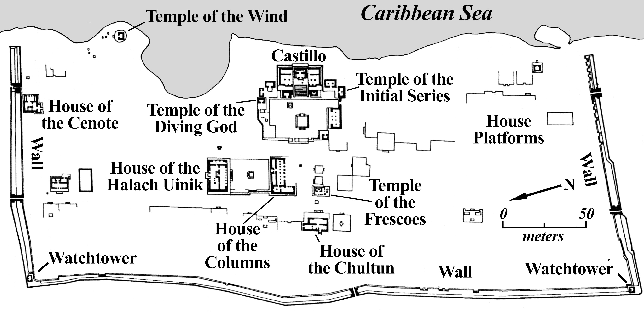
an important part of the Mayan empire during the years of 1200-1530 AD.  One of the last cities built and inhabited by the Maya, it is believed the original name of this port city was "Zama", meaning City of Dawn.  The name was later changed to Tulum, the Yucatec word for "wall", "fence" or "fortification", most likely because of the defensible 26-foot thick, 9- to 16-foot high walls on the three land-bound sides of the city, with a 39-foot limestone cliff on the ocean side.  Entrance to the city was via one of five tunnels through these formidable walls.


Tulum - Vibrant Hub of Trade


Tulum - One of the few Mayan cities built with a wall
In its hay-day, with an estimated population of 1,000 to 1,600 inhabitants, Tulum was a thriving trade hub for obsidian, turquoise and jade. Maintaining trade routes all the way down to Belize, other goods imported and exported from Tulum included salt, textiles, ceramics, copper and gold.  The vast majority of the city’s residents lived outside the walls, leaving the interior for the residences of the ruling class and ceremonial structures. A small cenote near the northern side of the wall provided the city with fresh water.


The Prominent Structures of Tulum


El Castillo - the castle
The dominating structure in the city was "El Castillo", the castle.  Once covered in stucco and painted in brilliant reds, yellows and blues, it appears to have been built as the main tower to keep a watchful eye over both the city and sea.  A small shrine on the tower appears to have been used as a beacon for seafaring canoes. This shrine marks a break in the barrier reef that is opposite the site. Here there is a cove and landing beach in a break in the sea cliffs that would have been perfect for trading canoes coming in.  Other prominent structures were the "Templo de las Pinturas", the temple of the frescoes, which appears to have been used as an observatory to track the movements of the sun.  The third major structure appears to have been an important site for the worship of the "diving" or "descending" god known to the Mayans as Kukulcan.  Depicted as and upside-down figure on the "Templo del Dios Descendente", he is also known as the bee god and seems to be associated with the setting sun.


Kukulcan - the Descending God
The Mayans maintained occupancy of Tulum up until the early 16th century. The city managed to survive about 70 years after the Spanish began occupying Mexico.  However, by the end of the 16th century, thanks to the introduction of disease, and the disruption of the Mayan society by the Spaniards, this former stronghold had been completely abandoned.


Visiting the Ruins of Tulum


Being a relatively small archeological site, it is possible to experience Tulum in only a couple of hours, making it ideal to combine touring this site with another half-day excursion nearby like Xel Ha, Xcaret or Playa Del Carmen.  Unlike Chichen Itza further inland, visitors may escape the heat by traversing the stairs to the beautiful beach below and taking a refreshing dip in the sea.  That being said, don't forget to bring the basics - water, a hat, and sunscreen - with you to prevent dehydration and heat exhaustion, as temperatures in this area can get very warm during parts of the year.  Also, remember to wear cool, breathable clothing, a comfortable pair of walking shoes, and insect repellent.  And don't forget your camera and money for souvenirs.  Even though it is one of the most visited Mayan ruins, Tulum is generally never over-crowded.  And for you wildlife admirers and photographers, you will be happy to know iguanas and butterflies are often in abundance here.

So don't forget during your travels to the Yucatan Peninsula to take some time out during your vacation to escape to the past and visit this majestic reflection of Mayan society perfectly placed as the only Mayan ruin to be found along Mexico's Caribbean coastline..."Riviera Maya".


Like what you've read? Want to learn how to better enjoy your scuba diving vacation? Maybe you'd like to travel with Delightful Departures on an upcoming adventure? Become part of the Delightful Departures community. Discover different destinations and travel tips in our biweekly newsletter.  Join today.

Join Our Community


Thursday, June 7, 2018

How Far In Advance Should You Plan A Scuba Vacation?

For all those scuba travelers out there who think the best way to get a great deal is to wait until the last minute - think again. Often times, you'll find the early bird gets the worm.  When you wait, you may find resorts in your desired destination are encountering high demand at that time, or worse, filled, and then there will be no bargains to be found.  And for those who do find that bargain basement deal, is it really all you wanted to experience in your vacation?

Those travelers who plan in advance generally have an advantage over the last-minute bargain hunters.  Working with a dive travel specialist, scuba travelers can mold their vacation to suit their tastes and needs. Creating the perfect trip that encompasses everything it should takes time.  Wait for a "deal" and be prepared to settle for something not so special.

So the question then is how far out should you start to think about your next adventure or relaxing getaway?  Well, there are 3 main factors to take into consideration:
  1. Where you want to go.
  2. What time of year you want to go.
  3. How important is it to you to create the ideal experience.

Where you want to go

Ideal planning times firstly depend on the destination. International scuba trips by their nature simply require more lead time than your average domestic vacation.  Trips to Asia or the Pacific islands should be booked far more in advance than a trip to the Caribbean. As a minimum, I say a good general rule of thumb would be for trips to Asia or a Pacific island, book at least 9-10 months out; Caribbean or Mexican destinations 3-4 months out; Central American destinations 6 months out; and South American or African destinations also 9-10 months out.  Liveaboards, no matter the destination, should be planned 12-18 months out to have a better chance at securing the itinerary and the type of cabin you desire.


What time of year you want to go

Most destinations will have definitive "seasons" - those times of the year when levels of demand vary. Generally resorts base their pricing on high season, low season, and the in between shoulder season. Traveling during high season, with its greatest level of demand because of preferred conditions, requires advanced planning for obvious reasons.  This can hold true for shoulder season as well, though to a slightly lesser degree. If you opt to travel to a destination during low season, this is when you have a lot more leeway.  This is when the last minute deals are to be had, but at a different price.  You should be aware that you are being offered the lower price because generally this season is during less than optimal conditions.

How important is it to you to create the ideal experience

Was there a special occasion you wanted to celebrate on this trip?  Was there a particular event you wanted to experience that only happens a certain time of year? What normally happens to last minute shoppers, especially during high or shoulder season, is that you are not able to plan your perfect trip. Now you have to settle for what’s left or don't go. It is not unusual when a diver waits until the last minute to contact me, that I put together a great proposal, only to have to come back to them the next day and say that the last room was booked, or that unique experience no longer has availability.

As we all know, scuba vacations are rarely cheap.  That's not to say you can't find a dive vacation package that isn't a great value.  But the last-minute dive traveler may not find the ideal experience he or she was searching for.  That said, if it is a choice between last minute travel or not at all, let's go.  However, an ideal vacation is more than a financial investment.  It is an investment in the enrichment of your soul and well-being.  Isn't that worth spending time to craft the experience to what you need?


Like what you've read? Want to learn how to better enjoy your scuba diving vacation? Maybe you'd like to travel with Delightful Departures on an upcoming adventure? Become part of the Delightful Departures community. Discover different destinations and travel tips in our biweekly newsletter.  Join today.

Join Our Community


Monday, May 28, 2018

Flying Can Be A Real Pain In The Buttocks - Literally

Do you ever feel like a twisted pretzel when you get off of a plane?  I know I do.  My husband always laughs at me because, with my smaller stature, I can manage to curl myself into some interesting positions in a plane seat in my efforts to catch some zzz's.  But because of this, I often feel some interesting aches and pains when it is time to stand up and move.  

So what do I do to try to combat these plane pains?  Here are my hacks for those airborne aches.

Keep Hydrated


Drink plenty of water or other caffeine-free beverages, such as fruit juices to remain hydrated.  Make sure to do this while on the plane and off.  Keeping your body well-hydrated helps minimize muscle aches and keeps you feeling refreshed.

Do Some Simple Stretches


If you are on a long international flight, try to get up and walk the aisle a bit, when you are allowed.  If you can't do that, then do a couple of simple neck stretches like bringing your chin to your chest, or your ear to your shoulder.  Make sure you are sitting up straight when doing this for proper stretching.  Also, you might want to roll your shoulders forward and backward.

When you are waiting at baggage claim for your luggage, you can loosen up with a few quick calf or quad stretches.  Do a small backward lunge to stretch your calf and hold for 30 seconds, then switch sides.  For you quads, grab one of your feet and pull it toward your buttocks and hold.  If you need, use a nearby wall, or the shoulder of your travel companion, to balance on.

Once you get settled in your room at the resort you can do a few more stretches for stretching your buttocks and relaxing the muscles in your back.  First, lay on the floor.  Cross your right ankle over your left knee in a figure-four pose, interlace your hands underneath your left thigh, and gently pull this leg toward your chest.  Switch sides.

Finally, you can do some classic yoga stretches like the cat-cow and the downward dog-cobra-child poses.  Always remember to breath through your stretches for better results and to feel more refreshed.


Change Your Clothes


Whether your are making that final connection for the short hop to your destination, or you've actually made it all the way to your resort, at a minimum, changing into fresh clothes can make you feel more comfortable.  Even your comfy old travel sweats can seem a bit binding after you've been compressed in a plane seat for a while. The act of just changing to something fresh, and preferably a little looser, will make your muscles feel a little less constricted.

Hot and Cold Therapy


If you have the time after you've settled in your room and your accommodations kindly provide you with a mini-fridge, then try this combo therapy method.  First, moisten a hand towel or washcloth and put it in the fridge for a few minutes to cool (do not freeze).  Take it out and massage your sore muscles with the chilled towel for up to 20 minutes (return the towel to the fridge as necessary to keep chilled).  After this, then you should follow up with a warm shower, or a nice soak in a hot bath.

Rub with a Rubber Racquetball


Maybe you've heard of or already use the technique of elongating your muscles with a foam roller, but this is not something you would give up valuable luggage space for; and you don't always have access to a gym at your resort which may or may not even have a foam roller.  So here is what I suggest, pack a firm rubber racquetball in your carry-on.  It is small and compact, and you can use it in small spaces to roll away any tight muscle knots you are suffering from.  Back in your resort room, you can place the ball between you and the wall, and roll it up and down to get to those hard to reach spots.

Try Arnica


Recently one of my coworkers introduced me to this homeopathic remedy.  There are oral doses available, but I suggest bringing along the gel formulation to apply topically to those achy muscles.  It may sometimes take a couple of days to fully kick in, but relief of inflammation and pain is on the way with consistent application.

Book a Massage


Finally, I highly suggest partaking of an exquisite massage.  I always schedule a massage or two on my vacations.  They are an absolute blessing after a long journey to your destination or at the end of an amazing scuba vacation.  Don't think of it as an unnecessary expense, but instead as an unforgettable addition of relaxation  to your getaway.  Plan ahead and ask your travel specialist to book a massage for you upon your arrival, and then you can always schedule another one with the spa while you are there once your dive days are done.
Trust me - you will never regret it!

How about you?  Do you have any tips you'd like to share to relieve those aches & pains from long flights?


Like what you've read? Want to learn how to better enjoy your scuba diving vacation? Maybe you'd like to travel with Delightful Departures on an upcoming adventure? Become part of the Delightful Departures community. Discover different destinations and travel tips in our biweekly newsletter.  Join today.

Join Our Community


Monday, April 30, 2018

KNOW BEFORE YOU GO...Travel Advisories & Warnings


You're sitting at your desk, staring at Google Earth on your computer screen, planning out your next travel adventure. You say to yourself, "Now wouldn't that be a cool place to visit?", but then you remember maybe you heard something on the news last night about some political unrest in that country. Maybe that isn't such a great place to go to after all. Or is it? Take a little time and do your research before you rule it out.

Did you know that you have resources at your fingertips to find out what is going on all around the world? There are agencies that post advisories about political unrest, terrorism, natural disasters and disease in order to alert travelers to what is going on in a region, you just have to know where to look. And just because a country has an advisory or warning posted, it may not necessarily be a country you don't want to visit. There just may be a certain region you should avoid. For instance, an island country took a direct hit from a typhoon, but maybe only the northern islands were affected while the remaining islands sustained no damage. Choosing not to visit this country all together could have a serious effect on this country's tourism trade and economy. Take time to delve deeper into what you hear on the six o'clock news and make sure you get the full story before ruling out that destination.

How Serious Do I Take That Warning?

You have to look at a particular warning and decide how it may actually affect your plans. To do this you may want to ask a few questions:

1) Does this warning encompass the entire country, or just a specific region?

Like I mentioned above, a natural disaster may only affect a portion of the country and not the country as a whole. Or in the case of political unrest, demonstrations and violence may be occurring in and around only one specific city, but some destinations away from that city may still be safe for tourists.

2) What exactly is the danger being specified in the advisory?

For instance, once again political unrest, are the demonstrations and violence being directed toward tourists, or are they strictly directed toward their own government entities and representatives. Another example is the typical annual advisory issued for the Atlantic and Eastern Pacific oceans every time hurricane season rolls around again. With this type of advisory, you may just want to make sure you have good travel insurance, or you pick another time of year to travel to that destination.

3) Is travel insurance an option?

Make sure you know what that travel insurance you are thinking of purchasing covers. Most policies do not cover acts of war, riots and/or civil disorder.

4) When was that travel warning or advisory dated?

If it has been several months since the last advisory was issued, you may just want to do some additional research to see what the current status in that country is. Things may have actually improved. A good source of information may be international news agencies.

5) Do other governments corroborate these warnings?

It has been speculated that some warnings are influenced or instigated by the current political atmosphere. You may want to check other English-speaking governments' websites (ie, Canada, the U.K., Australia and New Zealand, for example) to see if they are of the same opinion as to the state of the country to which you want to travel.

6) Is there a safety net for foreign travelers in that country?

Does your home country have an embassy or consulate established in that country? Is it fully staffed and functioning? Embassies are there to assist travelers who are in need of evacuating a country, or need to get in touch with loved-ones back home. Make sure there is some sort of assistance available to you should the worst happen.

To further educate yourself about what may be going on in the country you wish to visit, you may want to check out the following sites.

The U.S. Dept. of State has a page to assist the traveler with alerts  and warnings. They define "Travel Warnings" as an issue you might want to consider very carefully to determine if you wish to visit that particular country at all. A "Travel Alert" is a short-term issue you may want to know about when planning your trip. They also provide a wonderful travel resource page which links you up with all sorts of information from things like obtaining your passport or visa,  to various travel tips, to handling emergency situations abroad.

Homeland Security has a travel alert page which directs you to TSA, U.S. Customs and Border Protection, the Department of State, and the Centers for Disease Control and Prevention.

The CDC's website offers great information on what vaccines you may wish to get before traveling to a country, as well as advice to travelers on packing your prescriptions and over-the-counter drugs. They also provide travel health notices and updates for destinations around the world.

So what do I do if I decide to chance it and go anyway?

Many tourists often take the warnings into consideration, but choose to travel despite them. If that is your case, then make sure you cover your bases just in case.

1) Take your first STEP toward preparation.

The U.S. Bureau of Consular Affairs  offers a free service allowing U.S. citizens and nationals traveling abroad to enroll their trip with the nearest U.S. Embassy or Consulate. The benefits of enrolling in the Smart Traveler Enrollment Program (STEP) are:
  • The traveler will receive important information from the Embassy about safety conditions in their destination country to help them make informed decisions about travel plans.
  • Enrollment will assist the U.S. Embassy in contacting the traveler in an emergency, whether natural disaster, civil unrest, or family emergency.
  • It will also help family and friends get in touch with the traveler in case of an emergency.


2) Stay in touch.

Stay in touch with the folks back home by either email or phone. Not only will this let them know you are ok, but may keep you informed about what is going on in the world. Also, always leave a copy of your itinerary at home so that people will know where you are supposed to be and when in case you fall out of touch. (Also, leave a copy of your passport with them just in case it is lost or stolen.)

3) Have a plan just in case something does go wrong.

Find out the location of your country's embassy or consulate in the area(s) you will be visiting and make sure to carry a copy of the address and contact details with you. This could be a great resource in assisting you to return home in case of an emergency.

4) Be prepared. Stay safe.

Purchase that travel insurance plan. Check with your doctor to make sure you have the necessary vaccines. Use the links above to do your research. Inform yourself of the political and cultural atmosphere of the area to which you are traveling. And finally, learn the tips and tricks essential to avoid being a victim of tourist scams and other crimes.


Like what you've read? Want to learn how to better enjoy your scuba diving vacation? Maybe you'd like to travel with Delightful Departures on an upcoming adventure? Become part of the Delightful Departures community. Discover different destinations and travel tips in our biweekly newsletter.  Join today.

Join Our Community