Showing posts with label #divetravelexpert. Show all posts

Sunday, August 12, 2018

TRAVEL INSURANCE...who needs it?

Why should I buy travel insurance? Isn't it just a gimmick for my travel agent so they can up-sell me and get higher commission?


Given all the factors that could upset or interrupt that dream vacation you have been planning for forever now, is it worth the financial gamble not to buy that insurance? You hear it on the news everyday, political unrest or natural disasters around the world. Or, maybe it is a little closer to home; you suddenly fall ill, a family member passes, or you were on the way to the airport when you were in a traffic accident. Any or all of these events could spoil your chance at enjoying that long-needed vacation, and you could loose all those non-refundable dollars you invested in that trip.

So why invest in travel insurance?

To protect you against the unexpected; to protect your investment in this vacation; and simply to provide you with some peace of mind. Furthermore, it is best to keep in mind that when traveling to a foreign country, most regular health insurance plans provide only partial or absolutely no coverage for medical expenses incurred when abroad. And if you are covered by Medicare, there is definitively no coverage for health-care expenses outside of the United States.

And for those of us who are scuba divers, most health and life insurance plans do not cover accidents that occur during the participation in any hazardous sports.  And keep in mind if your vacation is on a liveaboard.  Your final destination may be far away from land, and if your luggage does not arrive with you, you may not see it until you return to land.  That is, unless you want to cough up some serious change to have it transferred to you.

What about my homeowners, life, and auto insurance policies? Doesn't my credit card have travel insurance already?


Your other insurance policies may cover some of the expenses, but once again, are often very limited when traveling abroad. Most credit cards who offer travel insurance have coverage that is limited to an low-level annual cap or a limited lists of reasons. Both trip interruption and travel delay coverage are limited as well. In addition, most credit cards do not cover medical expenses or evacuation.  And what about that insurance you purchase through the airlines you're flying with?  Well, it might cover minor expenses, but read the policy carefully.  Generally, the airline is out to cover itself more than you.

Aren't there always a bunch of "loopholes" hidden in the fine print?


As with any contract, read everything and do your best to understand it thoroughly. If you don't understand something, ask questions. Everything you need to know about your travel insurance plan is covered in the "Policy Certificate". And for consumer protection, all travel insurance companies provide a limited "Free Look Period" so that you may review your policy after purchase. If after purchasing a particular plan you feel it is not the right one for you, you can cancel it for a 100% refund, if you do it within the specified time period.

So what am I looking for in this fine print to avoid these "loopholes"?


1) Cancellation/Interruption Coverage
There isn't a policy out there that covers everything. Make sure to read the list of cancellation reasons covered in the Policy Certificate by a particular plan to ensure it meets your needs. If in doubt that you have all the coverage you need, you can generally opt to spend a little extra on a "Cancel For Any Reason" rider to cover all your bases.

2) Pre-Existing Conditions
Insurance is meant to cover sudden or unexpected events; not a condition that happened prior to the purchase of insurance. Many travel plans offer an optional waiver to the "Pre-Existing Condition Exclusion" for a small fee and based on a few requirements.
  • You must buy the insurance soon after your payment of your trip deposit (initial payment)
  • You must be medically cleared for travel at the time of purchase
  • You must insure the full cost of your trip
3) Coverage Exclusions
Read and understand your Policy Certificate for the general policy exclusions. Some examples of exclusions would be pregnancy-related issues, loss due to intoxication, self-inflicted injuries, etc.


4) Enrollment
Don't enroll too late. Get travel insurance within days of your first payment. This will maximize your period of cancellation coverage. If you get sick before you purchase insurance, it's too late. If that hurricane looming in the Caribbean is already named, it's too late.

5) Incomplete Documentation
Your Policy Certificate will outline the various documentation required to be submitted for a claim. For example, a cancellation claim due to injury or illness needs to be the result of a doctor recommending cancellation of the trip. If you have any issue that will affect or has affected your trip, contact your insurance company immediately and start saving all documents and receipts for submittal to cover your bases.

Remember, you can avoid the frustration of "loopholes" down the road if you take the time to read and understand your Policy Certificate, and buy your travel insurance plan early.

So what's this travel insurance going to cost me?


It all depends on the trip cost, your age, and the amount of coverage you choose. Generally, you can find a very basic plan for about 4% of your trip cost, or a premium coverage plan may go up to over 12% of your trip cost. If you opt to protect yourself by choosing a travel medical insurance only plan, the cost can be as few as dollars per day.

Ok, so maybe I will buy travel insurance after all. Where do I go next?


Well, if you book your travel through me, for your convenience, a quote from Allianz Travel Insurance will be sent directly to you at the time of booking.  The quote will be re-sent automatically one week later if you do not respond.  After that, if you choose to opt out, a waiver will be sent that says you have chosen to decline insurance.

For divers in particular, you have to remember your primary medical insurance may exclude scuba diving as a hazardous sport. If it does cover scuba diving, it may pay only a minimal amount for chamber treatment. Both the DAN (Divers Alert Network) and Diveassure Dive Accident Insurance Plans provide coverage locally and around the world. They are recognized worldwide and can be confirmed easily by a phone call 24 hours a day. Not only do these providers cover dive accident insurance, but dive travel insurance as well. No matter how many dives you do or how many trips you do in a year there are plenty of choices from either DAN or Diveassure. Both DAN and Diveassure have 3 levels of dive accident insurance to choose from.


           DAN Insurance                                                                                        Diveassure


Like what you've read? Want to learn how to better enjoy your scuba diving vacation? Maybe you'd like to travel with Delightful Departures on an upcoming adventure? Become part of the Delightful Departures communityDiscover different destinations and travel tips in our biweekly newsletter.  Join today.

Join Our Community


Saturday, July 28, 2018

5 Steps to Set the Stage for a Sensational Scuba Vacation

Planning a sensational scuba vacation can sometimes be a very stressful endeavor, especially when you want to get the best value for that precious time off.  So where do you start?  Well, organization is key to reducing stress, so I suggest you start with these 5 basic steps.  You know what is also key to reducing stress when it comes to your vacation?  Ask your friendly dive travel specialist to help.  That's why I'm here.  But back to the business of these 5 nuggets for creating your next delightful dive adventure.  There are often many factors to consider when planning a scuba vacation, especially to more remote destinations, but some of the basics include choosing the destination, picking the best time of year to travel there, and how to pack for this destination without breaking the bank with overweight baggage fees.  So to help you plan a dive trip that lives up to your expectations from start to finish, I've simplified the planning process into 5 basic steps.


Step 1:  Where Do You Want to Go?


Start out by jotting down a short list of destinations you want to experience.  Why do you want to go there?  Is it to see specific marine life?  Are you out to photograph a particular species?  Is it because you love a particular type of diving, like wreck diving?  

Are you looking for a destination that is friendly to particular requirements?  For example, you are traveling with children.  Your dive club prefers shore diving to boat diving.   Your group is comprised of a majority of inexperienced divers.

Finally, you will need to research some practicalities that may limit the destinations you choose.  This is where an expert comes in handy.  Your destination choice may be limited by your budget.  Or your chosen destination's visa and vaccination requirements may make going there more challenging then another destination.

Step 2:  What Type of Adventure Are You Considering?


Once you've narrowed down your options for a destination, then the next thing to consider would be what type of adventure would you prefer.  Explore what options are available to you at your chosen destinations.  Are you looking for a land-based resort?  One that is dive-dedicated or a more traditional boutique resort or hotel with access to dive operations?  Would you prefer to focus only on diving, or are you looking for a destination with many adventures available on land as well.  Or, maybe you would prefer to experience less land, and more dive sites, and are considering a liveaboard vacation.

Go back to Step 1. to remember the main purpose of this dive vacation.  Let's say, for example, if you opt for a destination focusing on a liveaboard experience, you need to consider if this is an optimal choice for a family-friendly vacation.

Step 3:  When to Go?


Your next step after narrowing down a possible destination is to research when is the best time of year to go.  A prime travel window may be dictated by Mother Nature and seasonal conditions, including factors such as weather, water temps, visibility, and ocean conditions (especially for liveaboard options).  For example, for the gamblers looking for low season pricing, the Caribbean during hurricane season may be an option, as long as you remember to purchase travel insurance to cover your bases.

Seasonality and migration patterns may also dictate a destination choice if your vacation is based on a target species.  For example, your destination choice, and travel window, may be based on the migratory patterns of hungry whale sharks or breeding gray whales.


Step 4:  How Are You Going to Get There?


After you've narrowed down the where, what, and when, you need to delve a little further into the how.  What does it entail to arrive at your chosen destination?  It may simply be a direct flight from your nearby hometown airport to the desired destination with a quick transfer to the resort.  Or it may be a bit more complicated, with multiple connections, long layovers, and both boat and land transfers to get to that remote island.  These details will undoubtedly factor into your budget and length of trip as well.

The devil is in the details.  When choosing your air transport, don't forget to factor in baggage fees.  And investing in travel insurance is generally a wise option, especially when committing to a more complex or expensive adventure.  Finally, it goes without saying that you should always keep your dive accident insurance current, whether you are diving locally or overseas.  It is a small price to pay for peace of mind.

Step 5:  Will This Destination Be Equipment Intensive?


When you combine all 4 steps above, the final step in this planning process is taking into consideration what type of gear will be needed.  If you are an occasional diver with no gear of your own per se, you will need to factor in what equipment will be required at this destination and how the price of equipment rental will factor into your budget.  If you are a prolific diver wisely set up with a full arsenal of lightweight travel gear, then you need to reflect on the type of diving you will be doing.  How much photo gear are you lugging along and can you fit that into the airline weight limits?  Are you night diving?  Will packing your lights be worth the weight?  Or would it be wiser and cheaper to rent lights from the destination dive operation?  If you are a tec diver, no doubt you prefer your own equipment, so you will definitely need to research airline restrictions before jetting off on your next adventure.

Finally, prepare a checklist for yourself of everything you wish to pack, from clothing to toiletries to dive equipment, to make sure nothing is forgotten.  I suggest you do a trial packing run at least the week before departure to figure out what needs to go, what could really stay, and how much it all weighs so there are no surprises at the airport or at your arrival at the resort.  Remember, to avoid stress when luggage arrives late or goes missing, pack you most important and most valuable items in your carry-on baggage.


Like what you've read? Want to learn how to better enjoy your scuba diving vacation? Maybe you'd like to travel with Delightful Departures on an upcoming adventure? Become part of the Delightful Departures communityDiscover different destinations and travel tips in our biweekly newsletter.  Join today.

Join Our Community


Friday, July 13, 2018

Bringing Your Vacation Memories Home

My husband always teases me that we could never run "The Amazing Race" and win because I would want to spend too much time stopping to take a picture of something. Ok, so maybe that could be true. I can't help myself. I want to catch the essence of what I am experiencing and bring it back to share, and inspire others to do the same.

Many of us are guilty of just taking a quick picture and then moving on... 

Many of us are guilty of just taking a quick picture of a building, a mountain, or a beach, and then just moving on. But your photos could hold so many more memories of what you were experiencing at that moment if you stop and absorb your surroundings. Take in the tiny details, or at the opposite spectrum, back up and take in a broader view. Sounds a little confusing? I'll explain myself.

I didn't get to catch this young group when they were playing,
but they quickly volunteered themselves for this picture when
they noticed my camera. I love their smiles. Don't you?
Say for example, you are on a Fijian island (one of my favorite places to be) and you decided to take a walk outside of your resort. You are strolling down a dirt road and you decide to snap a quick shot of the landscape. Now stop and take a moment to observe. Did you notice the group of young boys in the field next to the road playing soccer? Or did you look down along side of the road and notice that small bush of those spicy peppers you love to eat. Take a picture of the details. Capture the smiles of the boys as they play and when you are back home looking at that picture you will hear their giggles in your mind, bringing a smile to your face. Or focus your shot in on those bright red and orange peppers to remind you of the spicy dish you enjoyed that last evening you dined at your resort. Don't bring back just a bunch of pictures. Bring back photos that share the story of your memories.

Don't just take that "selfie" ...

At the other end of the spectrum is remembering to take in all your surroundings. Don't just take that "selfie" with a small portion of what may be a waterfall behind you. Or how about that wonderful shot of your husband in front of a tree? Back up. Shoot the picture of your husband in front of that tree on a path that leads to the rickety-looking wood and wire bridge you managed to survive using when you crossed that stream. And about that selfie, well maybe find some trustworthy soul to hand your camera over to. First, set up the shot so you can now see the ginormous waterfall cascading into this azure pool. Then hand over the camera and set yourself on that moss covered boulder. Now your friends back home can take in the beauty of where you were at that very moment and experience the essence of it for themselves.

The next step is to let your photos tell the story for you. Picture this...you and your friends have decided to go into town to experience the local cuisine. You all decide to lunch at this quaint sidewalk cafe. Now snap a series of shots. Take a picture of the streets signs so you can remember exactly what corner you were on when you look back at your city map. Take a picture of the cafe and the tables where you are sitting. Snap a shot of your friends perusing the menu. Another of someone sipping their beverage as you wait for your food. Food! Take a picture of your meal before you devour it so you can imagine the taste again when you try to replicate it at home. And for giggles, maybe take that shot of your husband stuffing that last bite of desert into his mouth. Now maybe take one more parting shot of the cafe a little way in the distance as you walk back down that city sidewalk, capturing the hustle and bustle that surrounded your lunch venue.

On a different note, here's a little tip that might come in handy when battling those pesky weight restrictions as you fight to stuff all your mementos into your suitcase before returning home. Try taking a photo rather than buying that souvenir. Want that wonderful wood carved mask, but it's too big for your suitcase and you can't afford to ship it home. Take a picture.

PUT THAT CAMERA DOWN...

Ok, now that I've told you what to do when taking pictures on your vacation, what I am going to say next may sound a little odd. PUT THAT CAMERA DOWN. Take a break from your photographic efforts. Remember that you need to experience the story as well as document it. Isn't that why you decided to take a vacation in the first place? Enjoy your artistic endeavors, but more so, enjoy being in that very moment and absorb it so that you can regale your adventure to your friends when you return home.

Found on designaglow.com
And when you get home, a cool idea to showcase your memories is to create a shadow box. Find one of those deep frames, or even one of those liquor gift boxes you see during the holidays that are made of wood and have a glass/plastic lid, and put your mementos like leftover coins, a coaster, postcard, ticket stubs, and some of your own photos in it. Believe it or not, you can find some great ideas on Pinterest if you are feeling uninspired.


Did I share the story with you?


Finally, I just wanted to share one of my favorites series of pictures I shot when visiting one of the small villages on the island of Beqa in Fiji.  This wonderful island has no roads to speak of, only a few villages and 3 resorts.  Absolute paradise to me.  The people are some of the warmest and most welcoming in the world. And the children are always curious. So I ask, does this series of photos share the story with you?


Do you have a favorite vacation photo that really tells your story that you would like to share? I'd love to see it!

Like what you've read? Want to learn how to better enjoy your scuba diving vacation? Maybe you'd like to travel with Delightful Departures on an upcoming adventure? Become part of the Delightful Departures communityDiscover different destinations and travel tips in our biweekly newsletter.  Join today.

Oxybenzone free sunscreen

Save 10% on your purchase when you apply the coupon code:  delightfuldepartures

Saturday, June 30, 2018

Can You Let Yourself Go With The Flow?


Often times our perfectly planned vacation doesn't go off without a hiccup.  How you react to that hiccup can then set the tone of the rest of your vacation.  So what do you do when you experience that bump in the road that you didn't plan for?

You know, thinking back I don't recall ever having a perfect vacation. And you know what, that's alright by me.  Although at the time it may have been an inconvenience, when I got home it generally added humor when I regaled with my friends my vacation stories.  Two particular journeys come to mind when I think of what could have been vacation lemons that were made into lemonade.


SO AS LUCK WOULD HAVE IT, A TYPHOON BLEW IN...


The first story took place on my very first international scuba vacation.  I jetted off to Beqa, Fiji, to experience my first time diving in warm, tropical waters and I was so excited to be traveling with a group of fellow divers.  Well, the trip had been planned around my dive shop's slow time of the year, which meant we were taking a chance on having excellent weather the whole time. So be it, luck was not exactly with us when a typhoon decided to blow through.  Now of course we couldn't go diving while the winds were howling and the rain was pouring, but were we going to let this ruin our good time? The choices were simple, yes or no.  Well one couple chose to complain to high heavens that this was not the vacation they had paid for and wanted to return home immediately. They opted for locking themselves up in their bure to pout until staff could safely transport them back to the main island of Viti Levu.  The rest of us, however, chose to go with the flow.  We broke out the umbrellas, hopped in the pool and played a raucous game of Marco Polo.  When the winds died down enough for safe sailing, the inpatient couple headed off, and the rest of us continued to enjoy the island, its wonderful people, and eventually some awesome diving.  Do you know what happened to that couple that couldn't just go with the flow and relax?  They sat in a hotel on the main island and had to wait until just the day before we were scheduled to depart before they could get a flight home.  Who do you think had a more enjoyable vacation with a wonderful story to tell when they got home?


MOTHER NATURE PLAYED HAVOC AGAIN...


The second story that comes to mind was when I led a group of divers down to La Paz, Mexico.  Generally, this area is not the victim of large hurricanes, but this had to be the year...just one month before we were to arrive, Baja was struck with one heck of a hurricane leaving a path of destruction from Cabo to Loreto.  I had my phone ringing off the hook and email blowing up from divers in the group wanting to know if we were still going.  When I was finally able to get in touch with the resort and ascertain that, although a little worse for wear, they were still open for business, I let the group know that although the resort may not be in stellar condition, I planned to still lead the trip and help support this community with my tourist dollars to aid in the recovery.  Thankfully everyone in the group was of the same mind and we flew on down.  So yes, we definitely did experience some challenges with plumbing and internet at the resort, but overall the place was in good shape.  On this trip though I did have one diver who admits now that he was not use to being able to let go and just find enjoyment in all the things that were going right. He finally confided in me at the end of the trip that when he realized that yelling at staff was not going to change the fact that some things could not be repaired instantly, his stress levels decreased and his enjoyment levels increased, and it turned out he had a wonderful time.  I felt quite rewarded when he told me that it was my example and attitude that influenced his change and taught him a valuable lesson.  There is peace in letting go and being flexible.


THERE IS PEACE IN LETTING GO & BEING FLEXIBLE...


So tell me, what do you think?  Do you have a story to share about how you turned lemons into lemonade on your vacation?  Didn't your hiccup just add color to what would have otherwise been a typical vacation story?  I'd love to hear from you.


Like what you've read? Want to learn how to better enjoy your scuba diving vacation? Maybe you'd like to travel with Delightful Departures on an upcoming adventure? Become part of the Delightful Departures communityDiscover different destinations and travel tips in our biweekly newsletter.  Join today.

Join Our Community


Oxybenzone free sunscreen

Save 10% on your purchase when you apply the coupon code:  delightfuldepartures

Tuesday, June 12, 2018

Tulum - The Mayan City of Trade on the Caribbean Coastline

As I prepare to embark on leading another group trip, I am looking forward to my surface interval adventure on the last day of our adventure before heading home.


Traveling Back in Time


Did you know in the state of Quintana Roo, Mexico, just a little over 80 miles south of the tourism metropolis of Cancun, you can step back into the ancient times of the magnificent Mayan world? Once a booming coastal port providing for the inland city of Cobá, Tulum still stands strong on a Yucatan coastal cliff above the aquamarine waters of the Caribbean Sea.  A reflection of this once thriving city, the well-preserved ruins now stand as the perfect insight into the Mayan way of life from centuries ago.


Last of the Mayan Cities


Tulum got its early beginnings sometime between 250-600 AD, but further developed into
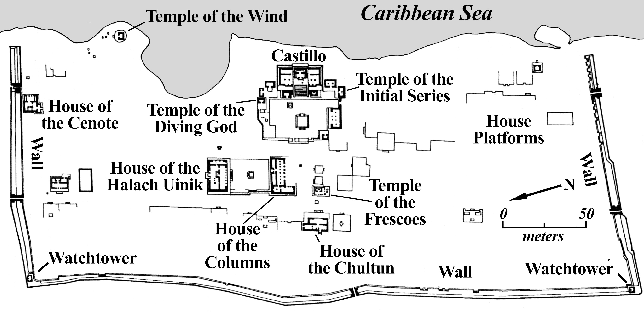
an important part of the Mayan empire during the years of 1200-1530 AD.  One of the last cities built and inhabited by the Maya, it is believed the original name of this port city was "Zama", meaning City of Dawn.  The name was later changed to Tulum, the Yucatec word for "wall", "fence" or "fortification", most likely because of the defensible 26-foot thick, 9- to 16-foot high walls on the three land-bound sides of the city, with a 39-foot limestone cliff on the ocean side.  Entrance to the city was via one of five tunnels through these formidable walls.


Tulum - Vibrant Hub of Trade


Tulum - One of the few Mayan cities built with a wall
In its hay-day, with an estimated population of 1,000 to 1,600 inhabitants, Tulum was a thriving trade hub for obsidian, turquoise and jade. Maintaining trade routes all the way down to Belize, other goods imported and exported from Tulum included salt, textiles, ceramics, copper and gold.  The vast majority of the city’s residents lived outside the walls, leaving the interior for the residences of the ruling class and ceremonial structures. A small cenote near the northern side of the wall provided the city with fresh water.


The Prominent Structures of Tulum


El Castillo - the castle
The dominating structure in the city was "El Castillo", the castle.  Once covered in stucco and painted in brilliant reds, yellows and blues, it appears to have been built as the main tower to keep a watchful eye over both the city and sea.  A small shrine on the tower appears to have been used as a beacon for seafaring canoes. This shrine marks a break in the barrier reef that is opposite the site. Here there is a cove and landing beach in a break in the sea cliffs that would have been perfect for trading canoes coming in.  Other prominent structures were the "Templo de las Pinturas", the temple of the frescoes, which appears to have been used as an observatory to track the movements of the sun.  The third major structure appears to have been an important site for the worship of the "diving" or "descending" god known to the Mayans as Kukulcan.  Depicted as and upside-down figure on the "Templo del Dios Descendente", he is also known as the bee god and seems to be associated with the setting sun.


Kukulcan - the Descending God
The Mayans maintained occupancy of Tulum up until the early 16th century. The city managed to survive about 70 years after the Spanish began occupying Mexico.  However, by the end of the 16th century, thanks to the introduction of disease, and the disruption of the Mayan society by the Spaniards, this former stronghold had been completely abandoned.


Visiting the Ruins of Tulum


Being a relatively small archeological site, it is possible to experience Tulum in only a couple of hours, making it ideal to combine touring this site with another half-day excursion nearby like Xel Ha, Xcaret or Playa Del Carmen.  Unlike Chichen Itza further inland, visitors may escape the heat by traversing the stairs to the beautiful beach below and taking a refreshing dip in the sea.  That being said, don't forget to bring the basics - water, a hat, and sunscreen - with you to prevent dehydration and heat exhaustion, as temperatures in this area can get very warm during parts of the year.  Also, remember to wear cool, breathable clothing, a comfortable pair of walking shoes, and insect repellent.  And don't forget your camera and money for souvenirs.  Even though it is one of the most visited Mayan ruins, Tulum is generally never over-crowded.  And for you wildlife admirers and photographers, you will be happy to know iguanas and butterflies are often in abundance here.

So don't forget during your travels to the Yucatan Peninsula to take some time out during your vacation to escape to the past and visit this majestic reflection of Mayan society perfectly placed as the only Mayan ruin to be found along Mexico's Caribbean coastline..."Riviera Maya".


Like what you've read? Want to learn how to better enjoy your scuba diving vacation? Maybe you'd like to travel with Delightful Departures on an upcoming adventure? Become part of the Delightful Departures communityDiscover different destinations and travel tips in our biweekly newsletter.  Join today.

Join Our Community